Tuesday, January 15, 2013

Yet more Van Gogh...


My next little breadcrumbs on the Van Gogh weaving trail led me to thinking about Van Gogh's painting surfaces. Sometimes he painted on linen, other times it was coarse jute and then sometimes he'd use something like a repurposed kitchen towel (torchon).

These surfaces were mentioned in Silverman's book and doing a bit more research led me to The Automated Thread Count Project and its work with The Van Gogh Museum. In short, X rays are used to look at the canvas under the paint which allows threads to be counted in an easier and more accurate way than by looking through a loupe. Matches have been made between Van Gogh's canvasses and other artists canvasses.

So I wanted to play with linen and similar materials and see where those explorations took me. A few glimpses of different work follow...


Friday, January 04, 2013

Van Gogh's Yarn Box

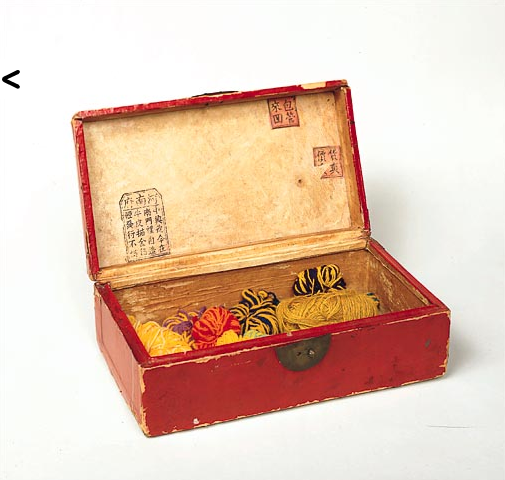
While I was reading Van Gogh and Gauguin by Debora Silverman, she mentions Van Gogh's yarn box. I was intrigued and hadn't remembered encountering the subject before. There's a black and white photo here along with an interesting read relating the yarn box and its possible relationship to the then new ideas of kindergarten, teaching children and play. Color photo here.

So, inspired by that object, I wanted to make some yarn to use in this Van Gogh/Weaving project. I wanted to include colors and textures that reminded me of Van Gogh - I don't yet know how I'll incorporate this yarn into the show project...below are two stages of the same yarn. Still thinking, but will post how I decide to incorporate into weaving.

Tuesday, December 11, 2012

A peek...

I love to see other artists' notebooks, so am doing a virtual notebook of my work for the Van Gogh/Weaving show. Sometimes those shadows and almost somethings...


become more clear when viewed later on. 


A peek at what indigo postcard is becoming...

Wednesday, December 05, 2012

Notes on woven strokes

I'm working on some pieces for a group show that relates Van Gogh to (and?) weaving. I wanted to make a few notes to myself as I go along, and since the show cannot include all of the thoughts around the process, thought I'd keep the notes here.

Van Gogh spent some time with the weavers in Nuenen around 1884 and wrote a bit then about his observations of the weavers. I've seen some of the drawings and paintings he made of them and wanted to read more of what he wrote about that time and experience. I also wanted to call upon my experience of standing in front of his wonderful paintings and create some work that would take into account my own process of creation - maybe marrying color, texture and explore some sculptural aspects - while incorporating weaving techniques.

One of the sources I started out with was "Van Gogh and Gaughin" a book by Debora Silverman. (Library copy) Pairing Silverman's analysis of Van Gogh's painting and process with Van Gogh's own writing (how wonderful to see Van Gogh's letters as he wrote them - the original script, in translation and with sketches!) on his process and observations was a good way in to thinking about how I'd like to respond to the subject.

So many possible approaches! Van Gogh used the weavers as subjects for drawings and paintings. He also contemplated the weaving process (as he saw it) and related the craft, materiality, design choices, aesthetic, and "philosophy" to his own artistic and spiritual searches.

I find myself remembering Portrait of the Postman Joseph Roulin from the MFA Boston. All that blue. I think of Van Gogh and indigo together - maybe it's just a cheap excuse to use the indigo that I love. The Postman, indigo, Sheila Hicks' woven letters (how did they get into my brain?!), Van Gogh's letters - the seen letters - (OK, maybe SH pieces got in there because I was thinking about letters?...) not any kind of linear process, that's for sure...

So, here we have our indigo and starting materials for a piece and I begin! To be continued...


Sunday, November 18, 2012

w---ing


Needed the loom so I set this one free...

Monday, March 07, 2011

Art Yarn, Revisited

The question of the week seems to be, "Can one make art yarn with spindles?" My response takes up more than a couple of sentences, so I'm posting here where I can wander a bit.


If you want a simple answer, that answer is yes. You can leave now to continue your stumbling in the dark. If you'd like to explore a bit deeper, read on and/or continue searching within yourself for the aspects of you that generated the question.

Here's a way that I start to think about the question...

First - if you are wondering if something can be done, why isn't your response to simply try and then observe the results. If you have asked a question, doesn't it seem that there is desire to know/explore an area? If you asked the question in a public forum and people responded, no it can't be done, would you not bother to try? Why would you accept someone else's answers?

In an area such as spinning, it's not like there are huge mistakes that can be made (these days.) No one will die if you try to spin a yarn and it doesn't work out the way you envisioned. You don't have to make a huge financial investment to try spinning what you're thinking about. You invest your time and then you know whether it can be done by you (at this time) or if you need more knowledge and/or need to find a teacher.

My second thought is - do you know what you are actually asking about? "Can one make art yarn with spindles?" What does the term "art yarn" mean to you? How do you define the term? I ask, because I have never seen a definition that satisfies me, that differentiates "yarn" and "art yarn" in any meaningful way. (I have written about this topic before.) Is there a reason for making these distinctions? For me there isn't. Often, calling one's yarn an "art yarn" seems to be done to cater to those who have a superficial understanding of creating/spinning in the hopes of making more money from the product and/or purporting to have a level of experience that one might not actually have.

I would say that I can make all kinds of yarns on spindles and wheels and I also teach others to do so. Candace Crockett, Mabel Ross and Diane Varney have all written excellent books on spinning and have shown techniques for manipulating fibers in creative ways. One can adapt these techniques for use with spindles and wheels.

These techniques are kind of a paint by number approach. After learning technique - what to do with your hands and what to do with the fibers and tools - what's next? Maybe one continues to refine technique, seeing how these techniques play out using different fibers, creating different weight yarns. This, in itself, could occupy a lifetime's worth of fun and experimenting. There are so many variations on types of yarn that can be created that one could be amused forever.

Depending on personality, needs, desires, technique explorations might be enough for an individual. For others, maybe one starts to be entranced by a different aspect - the expressive potential of spun fibers, an exploration of the extremes - how far can one push a technique or quality? Maybe beauty, ugliness, the embodying of the sensual play a role in developing one's yarns. Maybe portraying that which is beyond words is attractive to an individual. (And much much more...)

If one is attracted to any of the aspects mentioned in the previous paragraph, there are ways of interacting with them. One can look outside to what others have done. Why anyone would emulate or try to copy other peoples expressions is beyond me. Each of us has our own song, and singing anothers song, appropriating their work, can lead one away from one's self. If one wants to live on the surface of life and/or is happy to try to live someone else's life other than her/his own, maybe it will be a sufficient amusement.

Another way is to create from one's deep self, from one's experience of being on the Earth in this, our individual body in this time/space. That goes far beyond technique, and is an interaction that can tap into the most sacred of spaces, into all that humanity has explored and is currently exploring - experiences that fuel our most important human stories, our interactions with all the spirits of the Earth and our souls. One can learn so much by creating in this way, by allowing experiences to manifest themselves in spun fiber, to allow this fiber to be a holder of knowledge and energy.

Can the above be taught? I think that if that is the way one lives one's life, seeing each task and day as potentially sacred, the yarns that one creates will be a reflection of this. A teacher can help you to access these places in yourself, can point out some things that you might not have noticed and the possible significance for you.

Labels: , ,

Thursday, November 11, 2010

shifting sands!

i've moved - i live in a place where there's sand, not dirt, more water than land. the winds are relentless, the smells, sounds and visuals offer me so much beauty and inspiration - i hope i never forget to be grateful for all that i'm able to experience here in manomet. i'll post some photos of my travels/walks here while i continue to talk about spinning and art over here :)

Powered by Blogger